
AlJomaih Beverage Company Head Office HVAC Diagnostic Assessment
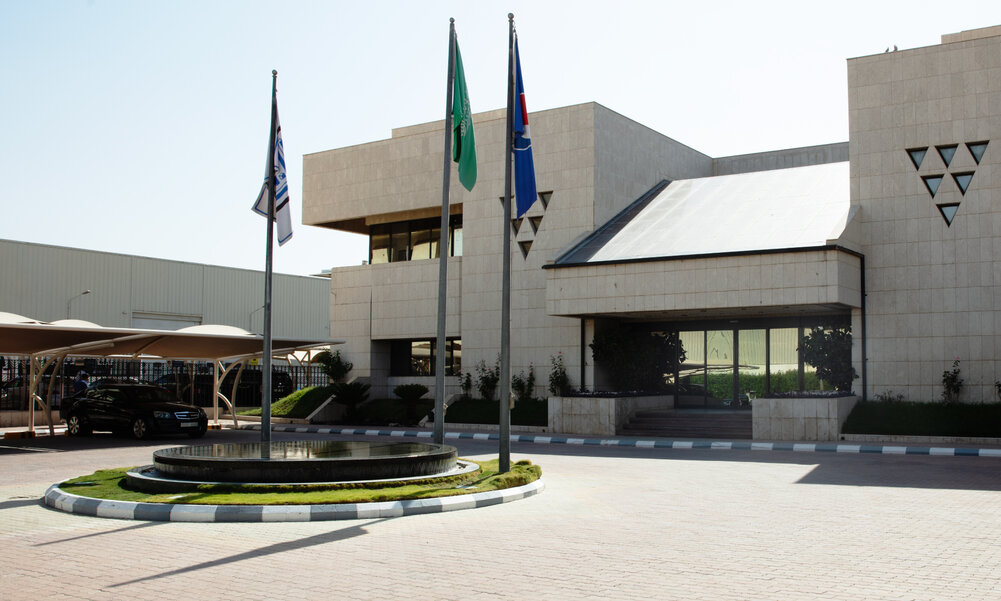
Project: AlJomaih Beverage Company, Head Office HVAC Diagnostic Assessment
Service: Consulting
Location: Dhahran, Eastern Province, Saudi Arabia
Client: AlJomaih Beverage Company (PepsiCo bottling franchise, Eastern Region of Saudi Arabia)
Status: Assessment completed; phased improvement roadmap delivered
Maintaining stable indoor conditions in office buildings located in Saudi Arabia’s extreme climate requires HVAC systems to respond not only to overall cooling demand, but also to changing solar loads, building orientation, glazing exposure, occupancy patterns, and internal zoning. AlJomaih Beverage Company engaged FREE energy to conduct a detailed HVAC assessment of its head office following recurring occupant complaints of high temperatures near glazed perimeter areas, excessive airflow noise, uneven cooling, and temperature differences between interconnected zones.
Prior modifications had introduced new thermostats and motorized volume control dampers for more localized temperature control. However, closing dampers in individual spaces increased airflow and noise elsewhere, while occupants near the eastern facade continued to experience discomfort in the morning and those near the western facade experienced elevated temperatures in the afternoon, indicating the issue could not be resolved through controls and zoning changes alone.
FREE energy developed a zone by zone HVAC load model using the building layout, orientation, envelope characteristics, glazing areas, occupancy, ventilation requirements, internal loads, and actual operating conditions. Cooling loads and required airflow rates were calculated using HAP and compared against the total capacity, sensible capacity, supply air conditions, and airflow capability of each installed packaged air conditioning unit. The assessment also factored in updated climatic design conditions, which showed peak cooling dry bulb temperatures had risen roughly 1.7 to 2.0 degrees Celsius compared with the earlier weather data used for the original system design, while cooling degree days had increased by 10.4%.
The analysis found that although most units retained sufficient total cooling capacity, several were operating with very limited sensible capacity and airflow margins during peak conditions, a critical distinction since a unit can appear adequate on rated capacity alone while still failing to manage a building’s high sensible heat gains along heavily glazed perimeter zones. FREE energy developed a phased improvement roadmap starting with restoring adequate cooling capacity in the most critical areas, followed by a full testing, adjusting, and balancing exercise to verify airflow distribution, reduce noise, and confirm correct supply air quantities per space, and finishing with a re-baselined control strategy covering zone airflow limits, pressure control, damper operation, and outdoor air logic.
This project demonstrates FREE energy’s ability to diagnose complex HVAC problems that cannot be resolved through equipment replacement or controls adjustment in isolation, combining site investigation, building load simulation, equipment capacity verification, climate analysis, and airflow assessment into a technically grounded roadmap for improving thermal comfort and HVAC reliability.